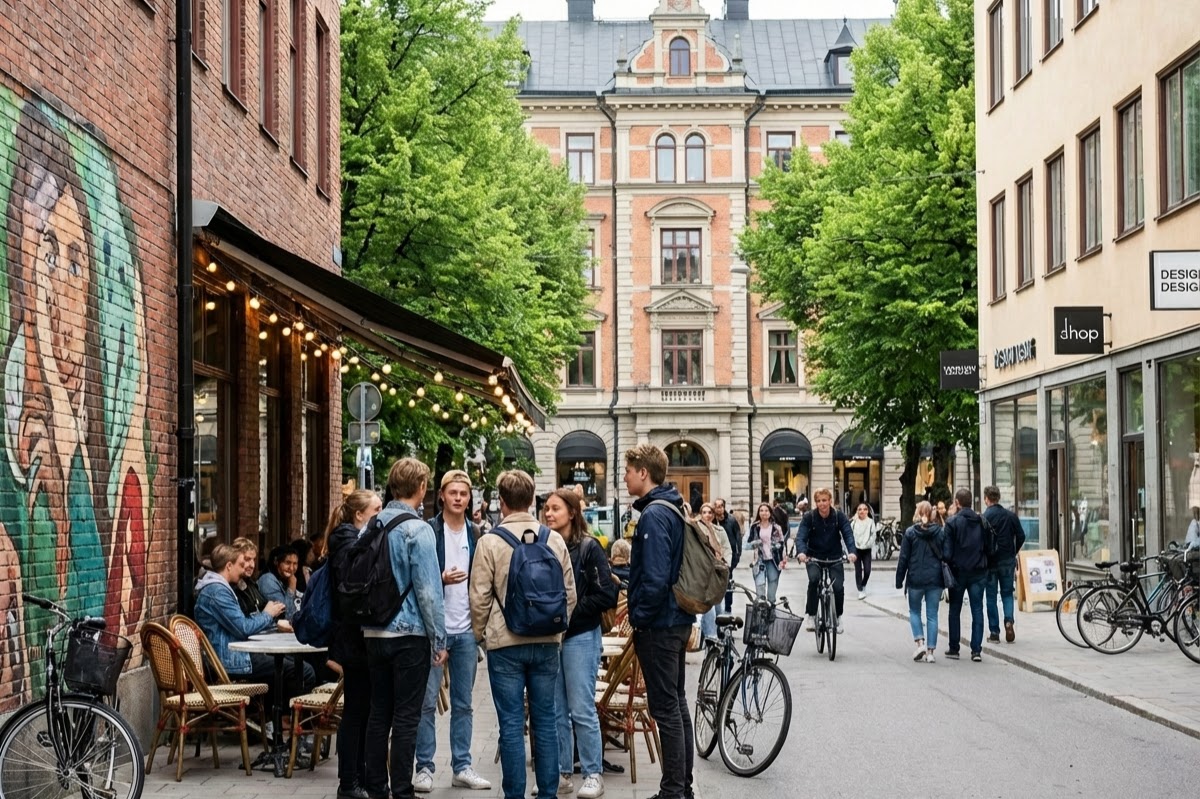
Study in Sweden
-
Capital:
Stockholm
-
Population
10 million
-
International Students
39,000
-
Universities
39
-
Currency
Swedish Kronor (SEK)
-
Capital:
Stockholm
-
International Students
39,000
-
Population
10 million
-
Universities
39








Sweden isn’t just known for IKEA, Spotify, Volvo, or beautiful landscapes. It’s also known for being one of the most progressive, sustainable, and student-friendly countries in the world. Every year, around 40,000 international students choose Sweden to pursue their academic dreams. It has world-class education, a welcoming culture, and an unmatched focus on creativity and innovation.
Whatever your career dream is, study in Sweden offers a unique blend of academic study and real-world learning. Its universities encourage curiosity, collaboration, and independent thinking. These are skills that employers across the world value most.
Sweden isn’t your typical study abroad destination, and that’s exactly why it should be at the top of your list. This Scandinavian nation consistently ranks among the world’s most innovative countries, has produced more Nobel laureates per capita than almost anywhere else, and offers a student-centred education system.
Let’s explore why Sweden might just be the perfect destination for your academic journey.
Estimate Your Study Abroad Expenses Instantly
Check Eligibility for Scholarships & Admissions
Why Choose Sweden for Your Studies?
Sweden ranks among the Top 5 countries in the world for quality of life, and its universities consistently appear in the Top 200 global rankings. But what truly makes Sweden special is its approach to learning, which is practical and designed to prepare students for the real world. Let’s look at some top reasons why you should consider studying in Sweden.
World-Class Education System
Swedish universities aren’t just good, they’re globally exceptional. With 8 universities ranked in the world’s top 200 (QS World Rankings 2024) despite having only 39 higher education institutions total, Sweden’s quality-to-quantity ratio is unmatched.
What makes Swedish education different? It’s the pedagogical approach. Swedish universities emphasise critical thinking, independence, and collaboration over memorisation and hierarchical learning. Professors aren’t distant authority figures – they’re accessible mentors you’ll call by first name! Classrooms encourage debate, questioning, and student-led discussions rather than passive listening.
Innovation Capital of Europe
Sweden invests 3.4% of its GDP in research and development, which is among the highest globally. It means as a student, you’ll access cutting-edge facilities, work on real research projects, and learn from renowned academics.
Swedish universities maintain strong industry partnerships with global companies. Studying engineering? You might work on projects with Volvo or Ericsson. Business student? Case studies with IKEA or Spotify are a reality. This industry connection isn’t just optional. It’s embedded in Swedish higher education philosophy.
Sustainability Leadership
If sustainability matters to you (and it should), Sweden leads globally. This is the nation that gave us Greta Thunberg, aims for carbon neutrality by 2045, and where almost 100% of household waste is recycled or converted to energy.
Whether studying engineering, business, social sciences, or arts, you’ll learn to think sustainably. With climate change on the rise, Sweden’s role in sustainability-focused fields carries significant weight globally.
Scholarship Opportunities for International Students
Here’s the reality: Sweden isn’t very cheap for non-EU/EEA students who pay tuition fees. But many don’t realise that a lot of scholarship opportunities exist, often covering full tuition and sometimes living expenses.
The Swedish Institute offers numerous scholarships specifically for students from developing countries, including Bangladesh and Nigeria. Universities themselves provide partial to full scholarships based on academic merit. Unlike some countries where scholarships are hard to secure, Swedish scholarships are genuinely accessible for students.
Permanent Residency (PR) Facilities
Sweden offers one of the most student-friendly pathways to permanent residency in Europe. After completing your studies, you can apply for a post-study work permit for up to 12 months to find a job or start a business. Once you’ve lived and worked in Sweden for 4 years, you can become eligible to apply for permanent residency (PR). This alone can be enough of a reason for students looking to study abroad to consider Sweden.
Free Education for Children & Health Insurance
Planning to settle with your family? Sweden ensures that your children get the best possible start, offering free, world-class education. This is a major advantage for international graduates planning a long-term future in Sweden with family.
Furthermore, Sweden’s healthcare system is among the most advanced globally. As an international student, you and your family can benefit from free medical care. So your worries will be less in case of a medical emergency.
English-Taught Programs
Swedish universities offer over 1,000 programs taught entirely in English, which is among the highest in non-English-speaking Europe. You don’t need Swedish language skills to study (though learning basics enhances your experience).
90%+ of Swedes speak fluent English. Daily life, from grocery shopping to banking to socialising, is completely manageable in English. You won’t feel isolated or struggle with basic communication like in some non-English-speaking countries.
Exceptional Quality of Life
Sweden consistently ranks among the world’s top 5 countries for quality of life, safety, and happiness. As a student, this means you will have a safe environment, work-life balance, a progressive society where Equality, inclusivity, and sustainability are daily realities, and excellent public services. Sweden’s natural view is also among the best in Europe.
Work While You Study: No hourly limits on part-time work during studies, like in other countries. You can work as much as you want without hampering your education.
Post-Study Work Opportunities
Sweden offers international graduates a 12-month residence permit to seek employment after graduation. Once employed in your field, transitioning to a work permit is straightforward. Also, Sweden’s pathway to permanent residence after four years of residence (including study time) makes long-term settlement realistic for those who choose it.
With Sweden facing skills shortages in engineering, IT, healthcare, Business, and Agriculture, international graduates with Swedish degrees are genuinely welcomed into the workforce.
No Requirement for Field-Related Jobs for PR Eligibility
Unlike many other countries, Sweden does not restrict PR eligibility based on your field of study or occupation. As long as you have stable employment and meet the residency duration requirement, you can apply for PR, regardless of whether your job is related to your degree. This flexibility gives graduates more freedom to explore diverse industries and career paths while building a life in Sweden.
When Can You Start? (Available Intakes in Sweden))
Swedish universities usually offer two major intakes:
Autumn Intake (August–September): Main and most popular intake.
Application period: October to January (previous year).
Spring Intake (January): Limited programs available.
Application period: June to August (previous year).
Tip: Start your application process at least 6–8 months early to maximise your chances of admission and scholarship consideration.
Application Through University Admissions
Unlike some countries where you apply directly to universities, Sweden uses a centralised application portal called University Admissions (www.universityadmissions.se) for most programs. You can apply to up to eight programs with one application and one application fee (SEK 900, approximately $85 USD).
Top Universities & Courses in Sweden
Sweden is home to some of the world’s most innovative and globally ranked universities. Here’s a closer look at the top universities that attract thousands of international students every year:
Lund University: Ranked #95 in the QS World University Rankings 2025, Lund University was founded in 1666. It’s located in Lund city and known for its vibrant international community and strong research environment. With over 45,000 students from 130+ countries, Lund blends academic excellence with a multicultural experience.
KTH Royal Institute of Technology: KTH is Sweden’s highest-ranked technical university and stands at #73 globally for Engineering & Technology. Located in Stockholm, it has been driving innovation and technological advancement for over 200 years. KTH graduates are among the most sought-after in Europe. With close ties to industry leaders such as Ericsson, Scania, and Volvo, KTH provides hands-on research opportunities and career pathways for engineering students.
Uppsala University: Founded in 1477, Uppsala University is Sweden’s oldest and one of Europe’s most respected academic institutions. It has a long-standing legacy of excellence in medicine, law, humanities, and natural sciences. With over 50,000 students, it offers a lively international student scene. Uppsala has produced Nobel laureates and thought leaders for centuries. You can be one of them, too!
Chalmers University of Technology: Located in Gothenburg, Chalmers University of Technology is renowned for its focus on sustainability, green energy, and technology-driven innovation. It consistently ranks among Europe’s top universities for engineering and environmental sciences. What makes Chalmers stand out is its deep commitment to solving real-world problems through research collaboration with industry giants like Volvo and SKF.
Stockholm University: As one of the largest universities in Sweden, Stockholm University is ranked #150 globally. Situated in the beautiful capital city of Stockholm, it offers students the perfect mix of academic excellence and urban vibrancy. Stockholm University’s research in climate science, political studies, and information technology is internationally acclaimed. Its closeness to the headquarters of major international companies creates huge internship and networking opportunities for students seeking a global career.
Linköping University: It is widely recognised for its applied approach to education. Linköping University’s strengths lie in engineering, natural sciences, medicine, and technology management. Known for producing job-ready graduates, it has strong connections with Swedish industries and research organisations, ensuring excellent employability for international students.
Jönköping University: Located in southern Sweden, Jönköping University is one of the most international universities in the country, with nearly 2,000 international students from over 80 countries. It’s best known for its globally oriented programs in business, economics, media, and entrepreneurship. The university maintains close ties with the business world, offering extensive internship opportunities and career support.
Top Subjects for International Students
Sweden offers a wide range of study programs across various sectors.
Engineering & Technology
Computer Science & AI
Business & Management
Environmental Studies & Sustainability
Architecture & Design
Life Sciences & Medicine
Social Sciences & Humanities
Scholarship Opportunities in Sweden
Sweden offers some of the most generous scholarships in Europe for international students. Let’s look at some:
Swedish Institute Scholarships
The Swedish Institute (SI), a government agency, offers scholarships each year for international students and researchers coming to Sweden.
Swedish University Scholarships
Universities in Sweden offer a range of different scholarship programs for international students to help finance tuition fees or living costs. Available scholarships vary between universities.
Other Scholarship Opportunities
In addition to government agency funding, competitions, and individual university scholarships, many associations, foundations, and other organisations offer scholarships and travel grants for international students in Sweden.
To learn more about scholarships in Sweden and to understand which one is best suited for you, contact AGP. We provide Free counselling & career guidance.
Fun fact: Over 50% of international students in Sweden receive some form of scholarship or financial assistance.
Tuition Fees & Living Cost in Sweden for International Students
Sweden offers premium education at a relatively affordable cost compared to other Western European countries. Let’s have a look:
Tuition Fees (Average per Year)
Bachelor’s: SEK 90,000 – 140,000 (≈ USD $8,500 – $13,000)
Master’s: SEK 120,000 – 190,000 (≈ USD $11,000 – $17,000)
These costs vary depending on the course and university. Engineering and business programs are typically on the higher end, while humanities and social sciences are more affordable.
Living Costs
Sweden maintains an excellent standard of living, and while it’s not the cheapest in Europe, students can manage expenses smartly. Here we made a monthly budget breakdown for you to give you better understanding of expenses.
Monthly Budget Breakdown
Accommodation: SEK 3,000 – 6,500/month ($280 – $610)
Student housing (most affordable): SEK 3,000-4,500
Private apartment (shared): SEK 4,000-6,000
Studio apartment: SEK 6,000-9,000+
Food: SEK 2,000 – 3,000/month ($190 – $280)
Transportation: SEK 400 – 800/month ($38 – $75)
Study Materials: SEK 500 – 1,000/month ($47 – $94)
Personal Expenses: SEK 1,500 – 2,500/month ($140 – $235)
Total Monthly Cost: SEK 7,400 – 13,800/month ($695 – $1,295)
Swedish Migration Agency Requirement: You must prove access to SEK 10,314/month (approximately $970) for living expenses when applying for a residence permit.
Cost-Saving Tips
Apply for student housing immediately upon acceptance. It’s significantly cheaper than the private market.
Cooking at home saves a lot. Sweden’s restaurant are very expensive.
Swedish second-hand culture (loppis markets, apps like Blocket) offers excellent deals on everything from furniture to clothing.
Use Student ID to get discounts on transport, museums, cinemas, and many shops.
Invest in a good bike. Swedish cities are incredibly bike-friendly, and biking eliminates transport costs
Work Opportunities in Sweden For International Students
International students in Sweden are allowed to work unlimited hours during their studies as long as it doesn’t hamper their academic performance.
Average part-time wage: SEK 120–160 per hour (≈ USD 10–15/hour).
Work Opportunities After Graduation
Students can apply for a 12-month post-study work visa to seek employment or start a business. Graduates often find full-time employment within 6 months. Once you secure employment, transitioning from a study permit to a work permit is straightforward.
After four years of continuous residence in Sweden, you’re eligible to apply for a permanent residence permit. After five years of continuous residence, you can apply for Swedish citizenship (Sweden allows dual citizenship).
Average graduate salary: £26,000-£40,000 per year
Top sectors: Software development/IT, Engineering, Healthcare professionals, Business & management, Research and academia
Tips to Prepare and Maximise Success for Sweden
Apply early for housing since student accommodations fill up quickly.
Write a strong SOP. Universities in Sweden value motivation and critical thinking.
Learn basic Swedish. Though not mandatory, it improves employability and networking.
Explore smaller cities. Universities in Linköping or Jönköping offer lower living costs.
State clear career goals in scholarship essays to secure scholarships easily.
Get a good bike and lights. Swedish cities are incredibly bike-friendly, and cycling is the cheapest, healthiest transport option.
Invest in good winter clothing, embrace winter activities (ice skating, skiing), and manage seasonal mood changes proactively.
Leverage AGP’s free counselling. We guide you through university selection, visa guidance & documentation, and scholarships.
How to Apply For Study in Sweden
Your Step-by-Step Application Process
Step 1: Research Programs (6-12 Months Before Start)
Browse University Admissions website (universityadmissions.se)
Research universities and programs thoroughly
Check specific entry requirements
Note application and scholarship deadlines
Step 2: Prepare Documents (4-6 Months Before Deadline)
Academic transcripts and certificates (officially certified)
Passport copy
English language test results
Motivation letter/Statement of Purpose
CV/Resume
Letters of recommendation (if required)
Portfolio (if required for creative programs)
Step 3: Create University Admissions Account (3-4 Months Before Deadline)
Register at universityadmissions.se
Upload required documents
Verify document authenticity as instructed
Step 4: Submit Application (By Deadline)
Select up to 8 programs in priority order
Complete application form thoroughly
Pay application fee (SEK 900)
Submit before deadline (typically mid-January for autumn, mid-August for spring)
Step 5: Apply for Scholarships (Often Earlier Deadline)
SISGP: Separate application, earlier deadline
University scholarships: Often automatically considered, but verify
Submit scholarship essays and additional requirements
Step 6: Await Results (2-3 Months After Deadline)
Admission results: Late March/April (autumn), October/November (spring)
Scholarship results: Similar timeline or slightly later
Check application portal regularly
Step 7: Accept Offer & Reserve Place
Accept your highest prioritized admission offer
Pay first tuition installment (if applicable)
Follow university instructions for confirming place
Step 8: Apply for Residence Permit (Immediately After Accepting)
Apply online through Swedish Migration Agency (Migrationsverket) and submit required documents.
Admission letter
Proof of funds (tuition + SEK 10,314/month living costs)
Valid passport
Health insurance
Pay application fee and wait for decision (1-3 months typically)
Step 9: Arrange Travel & Accommodation (2-3 Months Before Arrival)
Book flights
Arrange accommodation (accept student housing offers)
Research arrival procedures
Join university’s international student social media groups
Step 10: Arrive & Complete Registration
Arrive before semester starts (early arrival recommended)
Complete university registration
Obtain Swedish personal number
Open bank account
Attend orientation programs
Sweden offers something genuinely unique in international education. You’ll receive education that transforms you, experience one of the world’s most progressive societies, and build networks across a genuinely international academic community. You will also enjoy full time work opportunities during study and easier PR pathway.
Interested for Studying in Sweden? Need Expert Guidance? At Aspire Global Pathways, we’ve helped many students successfully start their Swedish education journeys with scholarships. We will support you every step – from your first counselling session to your first day in Sweden.
Apply now and take the first step toward your Swedish success story!
Why Choose Sweden for Your Studies?
Sweden ranks among the Top 5 countries in the world for quality of life, and its universities consistently appear in the Top 200 global rankings. But what truly makes Sweden special is its approach to learning, which is practical and designed to prepare students for the real world. Let’s look at some top reasons why you should consider studying in Sweden.
World-Class Education System
Swedish universities aren’t just good, they’re globally exceptional. With 8 universities ranked in the world’s top 200 (QS World Rankings 2024) despite having only 39 higher education institutions total, Sweden’s quality-to-quantity ratio is unmatched.
What makes Swedish education different? It’s the pedagogical approach. Swedish universities emphasise critical thinking, independence, and collaboration over memorisation and hierarchical learning. Professors aren’t distant authority figures – they’re accessible mentors you’ll call by first name! Classrooms encourage debate, questioning, and student-led discussions rather than passive listening.
Innovation Capital of Europe
Sweden invests 3.4% of its GDP in research and development, which is among the highest globally. It means as a student, you’ll access cutting-edge facilities, work on real research projects, and learn from renowned academics.
Swedish universities maintain strong industry partnerships with global companies. Studying engineering? You might work on projects with Volvo or Ericsson. Business student? Case studies with IKEA or Spotify are a reality. This industry connection isn’t just optional. It’s embedded in Swedish higher education philosophy.
Sustainability Leadership
If sustainability matters to you (and it should), Sweden leads globally. This is the nation that gave us Greta Thunberg, aims for carbon neutrality by 2045, and where almost 100% of household waste is recycled or converted to energy.
Whether studying engineering, business, social sciences, or arts, you’ll learn to think sustainably. With climate change on the rise, Sweden’s role in sustainability-focused fields carries significant weight globally.
Scholarship Opportunities for International Students
Here’s the reality: Sweden isn’t very cheap for non-EU/EEA students who pay tuition fees. But many don’t realise that a lot of scholarship opportunities exist, often covering full tuition and sometimes living expenses.
The Swedish Institute offers numerous scholarships specifically for students from developing countries, including Bangladesh and Nigeria. Universities themselves provide partial to full scholarships based on academic merit. Unlike some countries where scholarships are hard to secure, Swedish scholarships are genuinely accessible for students.
Permanent Residency (PR) Facilities
Sweden offers one of the most student-friendly pathways to permanent residency in Europe. After completing your studies, you can apply for a post-study work permit for up to 12 months to find a job or start a business. Once you’ve lived and worked in Sweden for 4 years, you can become eligible to apply for permanent residency (PR). This alone can be enough of a reason for students looking to study abroad to consider Sweden.
Free Education for Children & Health Insurance
Planning to settle with your family? Sweden ensures that your children get the best possible start, offering free, world-class education. This is a major advantage for international graduates planning a long-term future in Sweden with family.
Furthermore, Sweden’s healthcare system is among the most advanced globally. As an international student, you and your family can benefit from free medical care. So your worries will be less in case of a medical emergency.
English-Taught Programs
Swedish universities offer over 1,000 programs taught entirely in English, which is among the highest in non-English-speaking Europe. You don’t need Swedish language skills to study (though learning basics enhances your experience).
90%+ of Swedes speak fluent English. Daily life, from grocery shopping to banking to socialising, is completely manageable in English. You won’t feel isolated or struggle with basic communication like in some non-English-speaking countries.
Exceptional Quality of Life
Sweden consistently ranks among the world’s top 5 countries for quality of life, safety, and happiness. As a student, this means you will have a safe environment, work-life balance, a progressive society where Equality, inclusivity, and sustainability are daily realities, and excellent public services. Sweden’s natural view is also among the best in Europe.
Work While You Study: No hourly limits on part-time work during studies, like in other countries. You can work as much as you want without hampering your education.
Post-Study Work Opportunities
Sweden offers international graduates a 12-month residence permit to seek employment after graduation. Once employed in your field, transitioning to a work permit is straightforward. Also, Sweden’s pathway to permanent residence after four years of residence (including study time) makes long-term settlement realistic for those who choose it.
With Sweden facing skills shortages in engineering, IT, healthcare, Business, and Agriculture, international graduates with Swedish degrees are genuinely welcomed into the workforce.
No Requirement for Field-Related Jobs for PR Eligibility
Unlike many other countries, Sweden does not restrict PR eligibility based on your field of study or occupation. As long as you have stable employment and meet the residency duration requirement, you can apply for PR, regardless of whether your job is related to your degree. This flexibility gives graduates more freedom to explore diverse industries and career paths while building a life in Sweden.
When Can You Start? (Available Intakes in Sweden)
Swedish universities usually offer two major intakes:
Autumn Intake (August–September): Main and most popular intake.
Application period: October to January (previous year).
Spring Intake (January): Limited programs available.
Application period: June to August (previous year).
Tip: Start your application process at least 6–8 months early to maximise your chances of admission and scholarship consideration.
Application Through University Admissions
Unlike some countries where you apply directly to universities, Sweden uses a centralised application portal called University Admissions (www.universityadmissions.se) for most programs. You can apply to up to eight programs with one application and one application fee (SEK 900, approximately $85 USD).
Top Universities & Courses in Sweden
Sweden is home to some of the world’s most innovative and globally ranked universities. Here’s a closer look at the top universities that attract thousands of international students every year:
Lund University: Ranked #95 in the QS World University Rankings 2025, Lund University was founded in 1666. It’s located in the city of Lund and known for its vibrant international community and strong research environment. With over 45,000 students from 130+ countries, Lund blends academic excellence with a multicultural experience.
KTH Royal Institute of Technology: KTH is Sweden’s highest-ranked technical university and stands at #73 globally for Engineering & Technology. Located in Stockholm, it has been driving innovation and technological advancement for over 200 years. KTH graduates are among the most sought-after in Europe. With close ties to industry leaders such as Ericsson, Scania, and Volvo, KTH provides hands-on research opportunities and career pathways for engineering students.
Uppsala University: Founded in 1477, Uppsala University is Sweden’s oldest and one of Europe’s most respected academic institutions. It has a long-standing legacy of excellence in medicine, law, humanities, and natural sciences. With over 50,000 students, it offers a lively international student scene. Uppsala has produced Nobel laureates and thought leaders for centuries. You can be one of them, too!
Chalmers University of Technology: Located in Gothenburg, Chalmers University of Technology is renowned for its focus on sustainability, green energy, and technology-driven innovation. It consistently ranks among Europe’s top universities for engineering and environmental sciences. What makes Chalmers stand out is its deep commitment to solving real-world problems through research collaboration with industry giants like Volvo and SKF.
Stockholm University: As one of the largest universities in Sweden, Stockholm University is ranked #150 globally. Situated in the beautiful capital city of Stockholm, it offers students the perfect mix of academic excellence and urban vibrancy. Stockholm University’s research in climate science, political studies, and information technology is internationally acclaimed. Its closeness to the headquarters of major international companies creates huge internship and networking opportunities for students seeking a global career.
Linköping University: It is widely recognised for its applied approach to education. Linköping University’s strengths lie in engineering, natural sciences, medicine, and technology management. Known for producing job-ready graduates, it has strong connections with Swedish industries and research organisations, ensuring excellent employability for international students.
Jönköping University: Located in southern Sweden, Jönköping University is one of the most international universities in the country, with nearly 2,000 international students from over 80 countries. It’s best known for its globally oriented programs in business, economics, media, and entrepreneurship. The university maintains close ties with the business world, offering extensive internship opportunities and career support.
Top Subjects for International Students
Sweden offers a wide range of study programs across various sectors.
Engineering & Technology
Computer Science & AI
Business & Management
Environmental Studies & Sustainability
Architecture & Design
Life Sciences & Medicine
Social Sciences & Humanities

Scholarship Opportunities in Sweden
Sweden offers some of the most generous scholarships in Europe for international students. Let’s look at some:
Swedish Institute Scholarships
The Swedish Institute (SI), a government agency, offers scholarships each year for international students and researchers coming to Sweden.
Swedish University Scholarships
Universities in Sweden offer a range of different scholarship programs for international students to help finance tuition fees or living costs. Available scholarships vary between universities.
Other Scholarship Opportunities
In addition to government agency funding, competitions, and individual university scholarships, many associations, foundations, and other organisations offer scholarships and travel grants for international students in Sweden.
To learn more about scholarships in Sweden and to understand which one is best suited for you, contact AGP. We provide Free counselling & career guidance.
Fun fact: Over 50% of international students in Sweden receive some form of scholarship or financial assistance.
Tuition Fees in Sweden for International Students
Sweden offers premium education at a relatively affordable cost compared to other Western European countries. Let’s have a look:
Tuition Fees (Average per Year)
Bachelor’s: SEK 90,000 – 140,000 (≈ USD $8,500 – $13,000)
Master’s: SEK 120,000 – 190,000 (≈ USD $11,000 – $17,000)
These costs vary depending on the course and university. Engineering and business programs are typically on the higher end, while humanities and social sciences are more affordable.
Living Costs in Sweden
Sweden maintains an excellent standard of living, and while it’s not the cheapest in Europe, students can manage expenses smartly. Here we made a monthly budget breakdown for you to give you better understanding of expenses.
Monthly Budget Breakdown
Accommodation: SEK 3,000 – 6,500/month ($280 – $610)
Student housing (most affordable): SEK 3,000-4,500
Private apartment (shared): SEK 4,000-6,000
Studio apartment: SEK 6,000-9,000+
Food: SEK 2,000 – 3,000/month ($190 – $280)
Transportation: SEK 400 – 800/month ($38 – $75)
Study Materials: SEK 500 – 1,000/month ($47 – $94)
Personal Expenses: SEK 1,500 – 2,500/month ($140 – $235)
Total Monthly Cost: SEK 7,400 – 13,800/month ($695 – $1,295)
Swedish Migration Agency Requirement: You must prove access to SEK 10,314/month (approximately $970) for living expenses when applying for a residence permit.
Cost-Saving Tips
Apply for student housing immediately upon acceptance. It’s significantly cheaper than the private market.
Cooking at home saves a lot. Sweden’s restaurant are very expensive.
Swedish second-hand culture (loppis markets, apps like Blocket) offers excellent deals on everything from furniture to clothing.
Use Student ID to get discounts on transport, museums, cinemas, and many shops.
Invest in a good bike. Swedish cities are incredibly bike-friendly, and biking eliminates transport costs
Sweden Study Requirements
Academic Requirements
For Bachelor’s: Higher Secondary Certificate (HSC/A-levels) with strong grades
For Master’s: A relevant Bachelor’s degree from a recognised institution
Language Proficiency
IELTS: Minimum 6 overall (no band less than 5.5)
TOEFL: 90 iBT or equivalent
PTE: 62+
(Some universities also accept Duolingo or previous English-medium education.)
Supporting Documents
Academic transcripts
Statement of Purpose (SOP)
Letter(s) of Recommendation
Updated CV/Resume
Valid passport
Proof of financial capacity
Passport-size photographs
Work Opportunities in Sweden For International Students
International students in Sweden are allowed to work unlimited hours during their studies as long as it doesn’t hamper their academic performance.
Average part-time wage: SEK 120–160 per hour (≈ USD 10–15/hour).
Work Opportunities After Graduation
Students can apply for a 12-month post-study work visa to seek employment or start a business. Graduates often find full-time employment within 6 months. Once you secure employment, transitioning from a study permit to a work permit is straightforward.
After four years of continuous residence in Sweden, you’re eligible to apply for a permanent residence permit. After five years of continuous residence, you can apply for Swedish citizenship (Sweden allows dual citizenship).
Average graduate salary: £26,000-£40,000 per year
Top sectors: Software development/IT, Engineering, Healthcare professionals, Business & management, Research and academia
Pro Tips for Studying in Sweden
Apply early for housing since student accommodations fill up quickly.
Write a strong SOP. Universities in Sweden value motivation and critical thinking.
Learn basic Swedish. Though not mandatory, it improves employability and networking.
Explore smaller cities. Universities in Linköping or Jönköping offer lower living costs.
State clear career goals in scholarship essays to secure scholarships easily.
Get a good bike and lights. Swedish cities are incredibly bike-friendly, and cycling is the cheapest, healthiest transport option.
Invest in quality winter clothing, embrace winter activities (ice skating, skiing), and manage seasonal mood changes proactively.
Leverage AGP’s free counselling. We guide you through university selection, visa guidance & documentation, and scholarships.
How to Apply For Study in Sweden
Your Step-by-Step Application Process
Step 1: Research Programs (6-12 Months Before Start)
Browse University Admissions website (universityadmissions.se)
Research universities and programs thoroughly
Check specific entry requirements
Note application and scholarship deadlines
Step 2: Prepare Documents (4-6 Months Before Deadline)
Academic transcripts and certificates (officially certified)
Passport copy
English language test results
Motivation letter/Statement of Purpose
CV/Resume
Letters of recommendation (if required)
Portfolio (if required for creative programs)
Step 3: Create University Admissions Account (3-4 Months Before Deadline)
Register at universityadmissions.se
Upload required documents
Verify document authenticity as instructed
Step 4: Submit Application (By Deadline)
Select up to 8 programs in priority order
Complete application form thoroughly
Pay application fee (SEK 900)
Submit before deadline (typically mid-January for autumn, mid-August for spring)
Step 5: Apply for Scholarships (Often Earlier Deadline)
SISGP: Separate application, earlier deadline
University scholarships: Often automatically considered, but verify
Submit scholarship essays and additional requirements
Step 6: Await Results (2-3 Months After Deadline)
Admission results: Late March/April (autumn), October/November (spring)
Scholarship results: Similar timeline or slightly later
Check application portal regularly
Step 7: Accept Offer & Reserve Place
Accept your highest prioritized admission offer
Pay first tuition installment (if applicable)
Follow university instructions for confirming place
Step 8: Apply for Residence Permit (Immediately After Accepting)
Apply online through Swedish Migration Agency (Migrationsverket) and submit required documents.
Admission letter
Proof of funds (tuition + SEK 10,314/month living costs)
Valid passport
Health insurance
Pay application fee and wait for decision (1-3 months typically)
Step 9: Arrange Travel & Accommodation (2-3 Months Before Arrival)
Book flights
Arrange accommodation (accept student housing offers)
Research arrival procedures
Join university’s international student social media groups
Step 10: Arrive & Complete Registration
Arrive before semester starts (early arrival recommended)
Complete university registration
Obtain Swedish personal number
Open bank account
Attend orientation programs
Sweden offers something genuinely unique in international education. You’ll receive education that transforms you, experience one of the world’s most progressive societies, and build networks across a genuinely international academic community. You will also enjoy full time work opportunities during study and an easier PR pathway.
Interested in studying in Sweden? Need Expert Guidance? At Aspire Global Pathways, we’ve helped many students successfully start their Swedish education journeys with scholarships. We will support you every step – from your first counselling session to your first day in Sweden.
Apply now and take the first step toward your Swedish success story!
Get Clear Answers to All Your Study Abroad Questions
Ask Us Anything
Tuition fees in Sweden range from SEK 90,000 to 140,000 ($8,500-$13,000) for Bachelor’s and SEK 120,000 to 190,000 ($11,000-$17,000) for Master’s annually. Living costs average SEK 10,314/month ($970).
Yes! International students in Sweden can work unlimited hours during their studies without restrictions, earning SEK 120-160/hour ($10-15/hour) on average.
Yes! The Swedish Institute offers full scholarships, and universities provide merit-based funding. Over 50% of international students receive some form of financial assistance.
After completing studies, get a 12-month work-search permit, secure employment, and then apply for PR after 4 years of continuous residence in Sweden (including study time).
No! Sweden offers 1,000+ English-taught programs, and 90%+ of Swedes speak fluent English. Learning basic Swedish enhances employability but isn’t mandatory for studies.
Latest UK Blogs