Everything You Need to Know About Is Research Proposal Required for MRes, Admission Requirements in the UK, MRes vs MSc Difference & How to Apply
If you’re considering a Master of Research (MRes) in the UK, you might be wondering is research proposal required for MRes. The answer in most cases is yes and for good reason.
The MRes is fundamentally different from a standard MSC. It is a research-intensive degree where your independent project forms 60-70% of the entire programme. Universities need to assess whether you have a credible, well-defined research direction before offering you a place.
Because of this, you might be confused about the specific MRes admission requirements UK, or whether you can find MRes without research proposal UK universities.
In this comprehensive guide, we will break down absolutely everything you need to know for your upcoming UK intake. We will cover the crucial MRes vs MSc difference, guide you step-by-step through the research proposal writing process, and share expert insider tips to make your application stand out.
So, get comfortable, and let’s dive into the details of securing your UK MRes degree!
What Exactly Is an MRes, and Is Research Proposal Required for MRes?
When it comes to answering “is research proposal required for MRes”, the short answer is usually yes, but there are a few very important exceptions you should know about.
A Master of Research (MRes) is a highly specialised postgraduate degree. It is designed for students who want to focus heavily on independent research rather than traditional classroom learning. Typically, a standard MRes programme consists of 60-70% independent research work and a 30-40% taught component focusing on advanced research methodologies. Since the independent project forms the core of your degree, most UK universities want to see a clear, structured plan before they accept you.
So, is research proposal required for MRes in most everyday cases? Absolutely. A strong research proposal helps the admissions committee understand the exact “what,” “why,” and “how” of your intended project. It allows them to carefully assess whether your ideas are academically viable and whether you have a solid grasp of the subject area.
However, if you are applying for a funded studentship where the academic team has already designed the project, the answer to “is research proposal required for MRes?” can be no. In these rare cases, you are essentially applying to work on their pre-defined project, so writing your own proposal from scratch isn’t strictly necessary.
MRes vs MSc Difference: Which Master’s Degree is Right for You?
Understanding the MRes vs MSc difference is critical before you start preparing your UK university application documents.
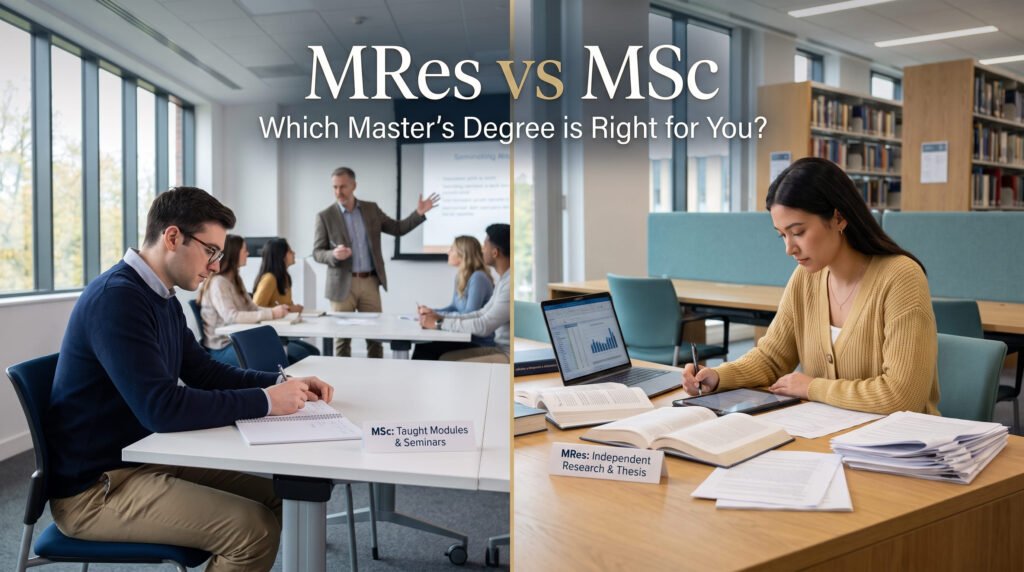
Many international students get confused when trying to choose between an MRes (Master of Research) and an MSc (Master of Science). While both are excellent, globally recognised postgraduate qualifications, their underlying structures, academic outcomes, and final assessment methods are very different. Knowing the core MRes vs MSc difference will ultimately help you align your degree choice with your long-term career goals. Let’s look at them closely.
Course Structure and Learning Style
The biggest difference between the MSc and MRes lies in the daily course structure. An MSc is a “taught” master’s, meaning you will spend the majority of your time attending regular lectures, participating in seminars, and completing coursework. Whereas during an MRes, the vast majority of your academic year will be spent conducting independent research, supported by just a few taught modules that focus purely on research methods.
Career Prospects and Academic Pathways
Another key difference between MSc and MRes is where the degree takes you after graduation. If your goal is to step straight into the corporate world or gain a broad, general understanding of a subject, an MSc is usually the better, safer choice. However, if you are firmly aiming for a PhD, a lifelong career in academia, or a highly specialised research and development role in your industry, an MRes provides the perfect foundation.
Application Complexity and Requirements
Since MRes is heavy and research-focused, the application process itself also differs greatly. For a standard MSc, a strong personal statement is usually more than enough. But for an MRes, you will generally need to draft a highly detailed academic plan. Understanding this brings clarity to the MRes vs MSc difference, proving why proper preparation is key.
What Are the Standard MRes Admission Requirements UK?
Meeting the core MRes admission requirements UK is your first major task to securing a spot at a top British institution.
The entry criteria of an MRes are generally much stricter than standard taught master’s programmes. To comfortably secure your admission in 2027, you need to ensure your academic profile matches the high, rigorous expectations of UK admissions boards. Understanding these crucial MRes admission requirements UK will help you prepare your documents well in advance.
Firstly, you will need a strong undergraduate degree. The standard entry criteria say that you must have a minimum classification of a 2:1 (Upper Second Class Honours) or its international equivalent. For highly competitive Russell Group universities, a first-class degree might be expected, particularly in competitive STEM (Science, Technology, Engineering, and Mathematics) subjects.
Secondly, English language proficiency is a mandatory part of the admission standards. You will typically need an IELTS Academic score of 6.5 overall, with no less than 6.0 in each component. Some heavily research-intensive programmes may even require a 7.0 overall, because you will be writing a lengthy, complex dissertation of 15,000 to 30,000 words.
Finally, you must provide excellent academic references. Most universities ask for two references, preferably from former lecturers or academic supervisors who can genuinely vouch for your independent research capabilities. Alongside these, your academic CV, transcripts, and personal statement must clearly highlight your future potential.
Want to get complete guidance for your MRes degree in the UK? Contact Aspire Global Pathways for free consultations today!
Can You Find MRes Without Research Proposal UK Universities?
Finding MRes without research proposal UK universities is technically possible, but you must know exactly where and how to look for these rare opportunities.
Many talented students feel intimidated by the prospect of writing a 2,000-word academic proposal from scratch before they even start their classes. If you fall into this category, you might be searching for MRes without research proposal UK universities. While very rare for self-funded, independent projects, there are specific scenarios where institutions will set aside this demanding requirement.
The most common way to find these specific universities is by applying for a “funded academic-led studentship”. In these unique cases, the university or a primary researcher has already secured government or private funding for a specific project. Since the project scope is already heavily defined, you only need to submit a strong CV and a passionate personal statement explaining why you are the best fit for the role.
Additionally, some institutions offer highly structured MRes programmes where the research topic is decided collaboratively alongside your supervisor during your very first semester. In these specific, tailored courses, the university might only ask for a brief “statement of research interest” rather than a full, referenced proposal.
However, if you are not applying for a predefined STEM project, you should assume the answer to “is research proposal required for MRes” is a yes. It is always much safer to prepare your research ideas well ahead of the university application deadlines.
How to Write a Winning MRes Research Proposal?
If you cannot find suitable institutions that skip an MRes research proposal, then mastering the art of proposal writing is your next step.
Writing a research proposal definitely does not have to be a terrifying, stressful experience. If you approach it systematically, it is simply a brilliant way to showcase your passion, academic capability, and critical thinking skills. When a university says yes to the question “Is a research proposal required for MRes?”, they are simply looking for a well-structured document that clearly outlines the viability of your future project.

The Essential Structure and Word Count
Your UK research proposal for MRes should generally be between 1,500 and 3,000 words, depending on the university’s guidelines. Start with a strong, highly specific working title and a clear introduction that clearly outlines your main research question. Follow this closely with a brief literature review to show the admissions team that you deeply understand the current academic conversation surrounding your topic.
Methodology, Impact, and Planning
Next, clearly and confidently explain your chosen methodologies. How exactly will you collect your data? Will you use qualitative, quantitative, or mixed methods? Furthermore, you must highlight the potential impact of your work. What bold new knowledge will your research bring to the table? How will people benefit from it?
Finally, always include a realistic project plan or timeline (often a Gantt chart) and a dedicated section addressing any potential ethical issues. This shows the admissions committee that you are a practical, highly organised researcher. Submitting a polished document easily ticks the box for the toughest admissions standards.
What Are the Top UK Universities for MRes in 2027?
Choosing the right institution is just as important as meeting the entry criteria, as different universities offer different research environments.
The UK is proudly home to world-renowned research institutions with cutting-edge facilities. If you are deciding where to apply, you must carefully look at their research facilities, industry connections, and supervisor availability. We have compiled a helpful table of top UK universities offering excellent MRes programmes to help you easily narrow down your choices.
| UK University | Key MRes Strengths | Are Proposals Typically Required? | Typical IELTS Requirement |
| University of Edinburgh | Outstanding interdisciplinary research culture. | Yes (unless funded studentship) | 7.0 Overall |
| University of Chester | Broad experience with 10-30k word dissertations. | Yes (often 2000+ words) | 6.5 Overall |
| University of East Anglia (UEA) | Internationally recognised for climate change, development, and language studies. | Yes (highly recommended to pitch an original topic or consult a supervisor) | 7.0 Overall (varies down to 6.0 depending on technical computing tracks) |
| Newcastle University | Renowned for innovative science & medicine research | Yes (varies by department) | 6.5 Overall |
| Wrexham University | Applied biomedical science research and career-driven technical fields | Yes (standard template or predefined project path required) | 6.0 Overall (widely renowned for flexible entry and broad 7-year MOI acceptance windows without taking an IELTS test) |
| University of Law | Career-focused legal, business, and criminological practice pathways | Yes (requires a structured proposal or research topic outline) | 6.5 Overall (with a minimum of 6.0 in each sub-score) |
Whether you are looking for highly ranked Russell Group institutions or searching for MRes without research proposal UK universities, always verify the exact entry criteria directly on the specific course page before applying.
Why Do Universities Ask, ‘Is Research Proposal Required for MRes?’
Understanding why universities ask for a research proposal helps you craft a much stronger and persuasive application.
Have you ever seriously wondered why UK universities are so strict about this specific requirement? When students ask, “Is research proposal required for MRes?”, they often mistakenly view it as an unnecessary, frustrating administrative task. In reality, it is the most vital assessment tool the university possesses to judge your potential.
First of all, your research proposal proves that you possess the advanced critical thinking skills necessary for postgraduate research. Unlike standard undergraduate degrees where you are often spoon-fed information, an MRes requires you to independently generate new knowledge. Your proposal proves you can successfully identify a valid, unexplored gap in the current academic literature.
Second, it acts as a crucial matchmaking tool between you and the faculty. A university simply cannot accept you if they do not have a faculty member with the specific, niche expertise to supervise your project. Your proposal allows the academic team to carefully review your topic and assign you the perfect mentor. Understanding this crucial MRes and MSc difference helps explain why standard taught degrees do not need this complex matching process.
Common Mistakes to Avoid When Applying for an MRes in the UK
Avoid these painfully common mistakes to ensure you effortlessly meet all entry requirements and secure your MRes spot in the next UK intake.
Even brilliant, high-achieving students get rejected if they make basic, avoidable errors during the application process. Now that you know the answer to “Is research proposal required for MRes,” you must ensure your final submission is absolutely spot on.
One highly common mistake is failing to contact a potential supervisor before officially applying. If you find a faculty member whose expertise perfectly aligns with your topic, email them a polite introduction and a summary of your idea. Getting their preliminary backing massively boosts your overall chances of admission.
Another very common error is writing a proposal that is far too broad. “The impact of climate change on agriculture” is a topic for a 10-year study, not a short one-year MRes. Keep your research question laser-focused, specific, and totally achievable within the standard 12-month timeframe.
Lastly, absolutely do not ignore the specific formatting guidelines. If a university generously provides a mandatory proposal template (like Wrexham University does), you must use it! Failing to follow basic administrative instructions can instantly ruin your otherwise perfect application.
Conclusion
Navigating the UK university application process can seem tiring, especially when tackling stressful questions. However, if you are equipped with the right, up-to-date information about standard MRes admission requirements UK, you can secure your place for the 2027 intake.
Looking for MRes without research proposal at UK universities is a valid option for funded STEM projects. But remember, dedicating time to write a well-researched proposal will open far more doors for your academic future.
Ready to start your research journey in the UK and need expert help with your proposal and visa? Let the industry experts guide you! Contact Aspire Global Pathways today for free personalised consultations and let us successfully guide you toward your MRes degree!
Frequently Asked Questions (FAQs)
Get quick, accurate, and highly optimised answers to your most common questions about UK Master of Research degrees.
1. Is research proposal required for MRes at all UK universities?
No, while the vast majority of self-funded programmes absolutely require one, you might not need it if you are applying for a fully funded, academic-led studentship where the project scope is already defined by the university itself.
2. What is the main MRes vs MSc difference?
The primary MRes vs MSc difference is the overall course structure. An MSc is mostly comprised of taught modules with a small dissertation at the end. Whereas an MRes is predominantly heavily focused on independent research (60-70%) with a few taught research methodology classes.
3. What are the general MRes admission requirements UK?
Standard MRes admission requirements UK heavily include a 2:1 Honours degree (or international equivalent), an IELTS score of 6.0 to 7.0 depending on the university, two academic references, a detailed academic CV, and usually a highly comprehensive research proposal.
4. Can I find MRes without research proposal UK universities?
Yes, safely finding MRes without research proposal UK universities is occasionally possible if you apply specifically for pre-defined research projects, funded studentships, or highly structured programmes that only require a “statement of research interest” instead of a full proposal. To get free expert guidance on the matter, contact Aspire Global Pathways now.
5. How long should an MRes research proposal typically be?
Typically, UK universities expect a standard MRes research proposal to be roughly between 1,500 and 3,000 words. You should always check the specific word count limits on the university’s official course page before submitting.