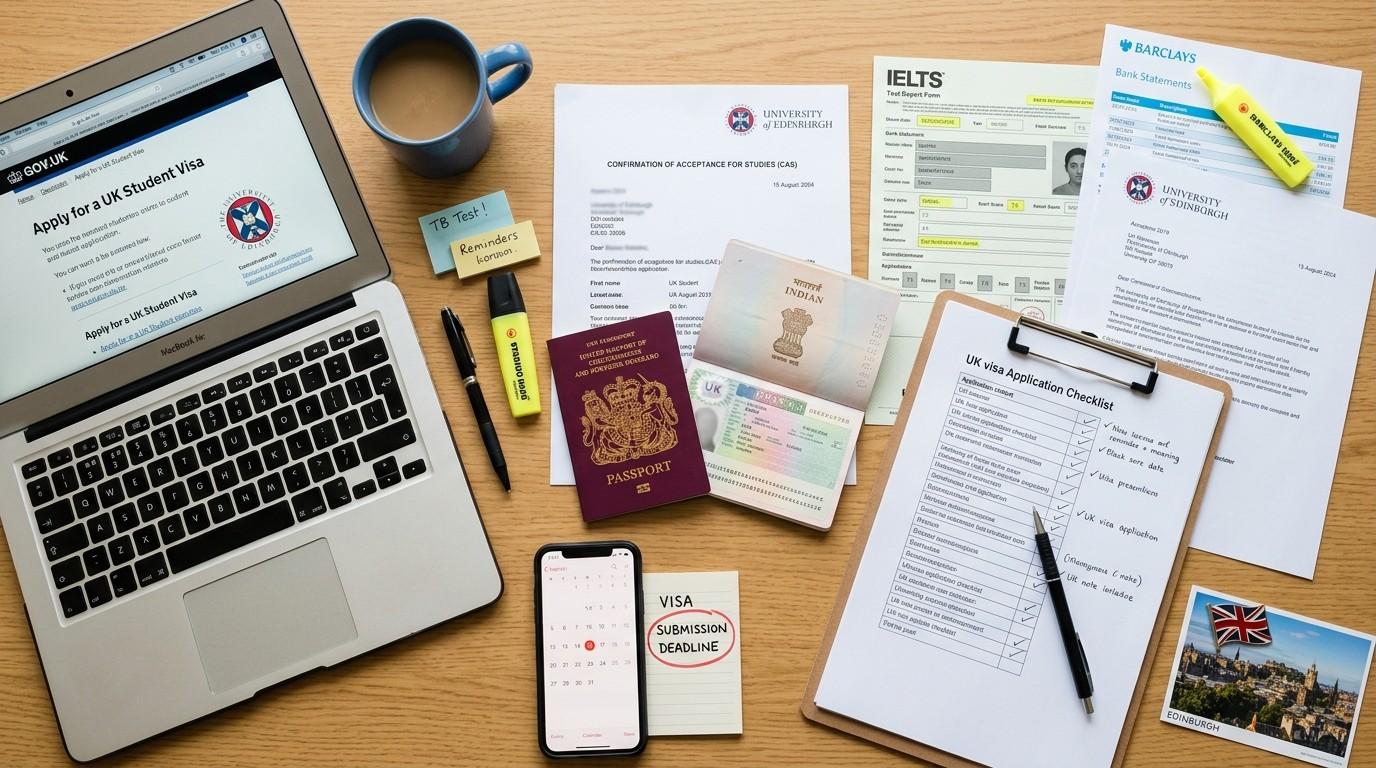
Getting rejected for a UK student visa feels gut-wrenching. For thousands of international students every year, this nightmare becomes a reality. But most people don’t know that almost 96% of UK student visa applications get approved. That means most rejections are completely avoidable.
According to UK Home Office statistics, of 444,905 student visa decisions made in 2025, only 18,434 resulted in refusal – a 4.1% rejection rate. The data shows that the UK wants international students. So why do some applications fail while others succeed? Let’s break down the most common UK student visa issues and, more importantly, how to fix them.
7 UK Student Visa Nightmares and Solutions
Here are the 7 most important student visa issues for the UK and their solutions.
1. Insufficient Financial Proof
This is the leading cause of UK student visa rejection. Applicants must prove they have enough funds to cover tuition fees plus living costs for at least 9 months. For courses in London, that’s £1,529/month (£13,761 total), and for outside London, that’s £1,171/month (£10,539 total). Students submitting bank statements with irregular deposits, unexplained large transfers, or insufficient balance documentation trigger immediate red flags.
The Solution
Maintain required funds in your account for a minimum of 28 consecutive days before application. Use bank statements dated within 31 days of application submission.
Clearly document the source of any large deposits (salary, sale of assets, or parent transfers).
If using parent/sponsor funds, include the official financial sponsorship letter and proof of relationship. Never borrow money temporarily to inflate your balance, since UK authorities verify the authenticity of funds.
Pro Tip: The 28-day rule is non-negotiable. One day short can lead to automatic rejection.
2. CAS Letter Mismatches
Your Confirmation of Acceptance for Studies (CAS) contains specific details such as course name, start date, tuition fees, and university name. If your visa application contains even minor discrepancies like different course title spellings, wrong start dates, or mismatched fees, instant rejection might follow.
The Solution
Cross-verify every single detail between your CAS and application form. Check:
- Exact course title (word-for-word match)
- Start and end dates
- Tuition fee amount
- University name spelling
- CAS reference number accuracy
A common mistake: UK universities sometimes issue amended CAS letters. Always use the most recent version and ensure your application reflects current information.
3. Credibility Interview Failures
Since 2024, UK authorities have increasingly conducted credibility interviews for applicants from certain countries. Students who cannot clearly explain why they chose the UK, their specific university, or their course face rejection. Vague answers like “the UK has good education” or the inability to describe course modules raise suspicions about genuine student intent.
The Solution
Genuinely prepare for these questions:
- Why the UK over other countries? (Be specific – mention research excellence, industry connections, post-study opportunities).
- Why this university specifically? (Reference faculty, facilities, course structure; show you researched thoroughly).
- Why this course? (Connect to career goals, explain how the curriculum aligns with your aspirations).
- What are your career plans post-graduation? (Demonstrate a clear professional roadmap).
Avoid visa rejection in the UK by practising answers out loud, knowing 3-4 course modules by name, understanding university rankings and reputation, and connecting course content to specific career outcomes.
4. Fake or Altered Documents
Submitting forged financial documents, altered transcripts, or fake English test certificates doesn’t just result in rejection – it triggers a 10-year UK entry ban for deception under immigration rules. UK authorities use sophisticated verification systems to detect document fraud.
The Solution
Simple! Never submit fake documents ever. If your genuine documents are weak:
- Improve them legitimately (retake English tests, save more funds, upgrade qualifications).
- Delay your application until the documentation is strong.
- Seek expert guidance on presenting genuine documents effectively.
UK student visa tips: Even innocent-looking “enhancements” (photoshopping bank statements, editing employer letters) count as deception. The consequences aren’t worth the risk.
5. Poor Academic Progression Logic
Applying for a bachelor’s when you already hold a master’s, switching from engineering to arts with no explanation, or pursuing a Level 4 diploma after completing a Level 7 qualification raises questions. UK authorities assess whether your chosen course represents genuine academic progression.
The Solution
If your course choice seems unusual:
- Write a detailed personal statement explaining academic/career rationale.
- Demonstrate how this course fills specific skill gaps.
- Show evidence of career research supporting your decision.
- Connect course choice to concrete professional goals in your home country.
Example: If you have a Business degree but apply for a Computer Science master’s, explain the digital transformation trend in your industry and how coding skills enhance business strategy expertise.
6. Incomplete or Incorrect Application Forms
Leaving sections blank, providing inconsistent dates across documents, or failing to declare previous visa refusals can lead to rejection. The UK application form specifically asks: “Have you been refused a visa from the UK or any other country?” Answering ‘no’ when you have previous refusals constitutes deception and will lead to rejection.
The Solution
Fixing UK visa problems starts with meticulous form completion and honesty:
- Answer every question completely – if not applicable, state “N/A”
- Ensure dates match across all documents (passport, transcripts, employment letters)
- Always declare previous refusals honestly with a brief explanation
- Have someone proofread your entire application before submission
- Keep copies of everything you submit
Reality check: UK authorities share information with other countries. They will discover undeclared refusals. Honesty is always safer than deception.
7. Inadequate English Language Proof
Submitting expired English test results (IELTS/PTE/TOEFL older than 2 years), submitting scores below university requirements, or using non-UKVI-approved test providers will result in rejection.
The Solution
- Take UKVI-approved IELTS/PTE/TOEFL tests only
- Ensure the test date is within 2 years of the application
- Meet or exceed the university’s minimum score requirements
- If exempted (previous education in English), provide proper documentation proving the medium of instruction

What If You’re Already Rejected?
Receiving a UK student visa refusal isn’t the end. Here’s how to recover:
- Step 1: Carefully read the refusal letter, identifying the exact reasons.
- Step 2: Address each issue specifically (save more funds, retake tests, correct documentation).
- Step 3: Wait an appropriate time before reapplying (depends on refusal reasons).
- Step 4: Submit a stronger application with clear evidence addressing previous gaps.
- Step 5: Consider including a cover letter explaining what has changed since the refusal.
Important: You can reapply immediately for most refusals (except deception bans). Demonstrate clear improvements addressing refusal reasons, and you are good to go!
At Aspire Global Pathways (AGP), we’ve helped thousands of students navigate UK student visa applications successfully. We understand exactly what UK authorities scrutinise.
Don’t let avoidable mistakes destroy your UK dreams. Contact AGP today for free expert UK student visa guidance!
Frequently Asked Questions (FAQs)
1. What is the UK student visa rejection rate in 2026?
The UK student visa rejection rate is 4.1% as of 2025 data (18,434 refusals out of 444,905 decisions). This means 95.9% of applications are approved. Most rejections stem from insufficient financial proof, document errors, or credibility issues – all avoidable with proper preparation.
2. Can I reapply immediately after a UK student visa rejection?
Yes, you can reapply immediately for most UK student visa refusals, except in cases of deception (which triggers a 10-year ban). Before reapplying, carefully address the specific rejection reasons mentioned in your refusal letter. Strengthen weak areas (finances, documentation, credibility) and submit a significantly improved application.
3. How much money do I need in my bank account for a UK student visa in 2026?
For a UK student visa in 2026, you need tuition fees plus £1,529/month (London) or £1,171/month (outside London) for 9 months. Example: £15,000 tuition plus £13,761 living costs equals £28,761 total for London courses.
4. What happens if I provide fake documents for a UK student visa?
Submitting fake or altered documents triggers a 10-year UK entry ban for deception under Immigration Rule SUI 9.1. This includes forged bank statements, fake transcripts, altered English test results, or fabricated employment letters. UK authorities use sophisticated verification systems to detect document fraud – the risk isn’t worth it.
5. How can I prepare for a UK student visa credibility interview?
Prepare specific answers explaining: (1) Why the UK over other countries, (2) Why this specific university, (3) Why this course, (4) Your career goals. Research your university thoroughly, memorise 3-4 course modules, understand faculty expertise, and clearly connect your course to career plans. Vague or inconsistent answers raise red flags and can lead to rejection. Prepare correctly.