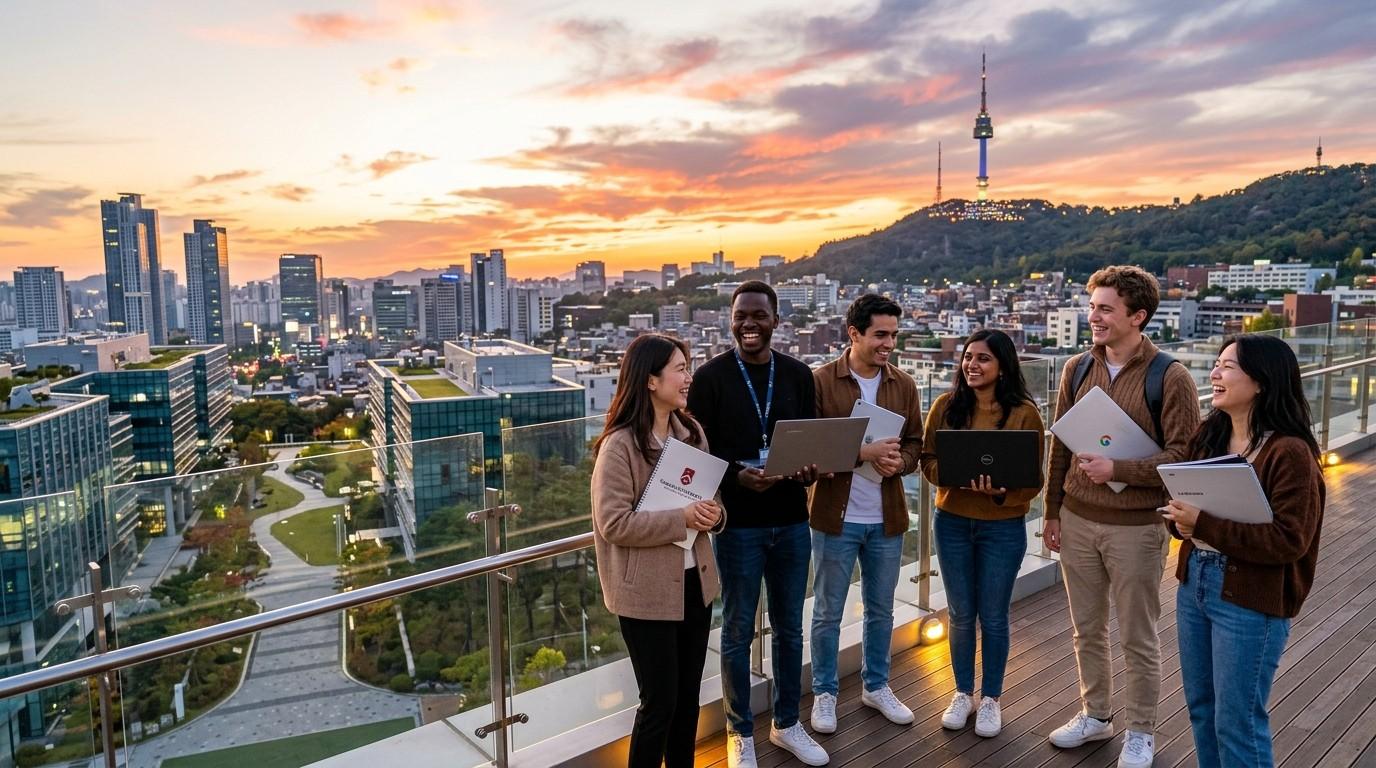
Forget what you know about studying abroad. While traditional Western destinations are tightening their borders, a new academic powerhouse has risen steadily. If you are planning your future abroad, deciding to study in South Korea can be the smartest career move in 2026.
The South Korean government is welcoming international students with open arms. What does this mean for you? It means generous funding, smoother visa processing, and relaxed post-graduation work rules.
Here is exactly why making the move to South Korea is a game-changer and how you can navigate the opportunities ahead.
World-Class Academics Without the Language Barrier
When looking for the best universities in South Korea, you are looking at institutions that outrank many Ivy League and Russell Group schools in engineering, IT, and business. The legendary “SKY” universities (Seoul National University, Korea University, and Yonsei University), alongside tech giants like KAIST and POSTECH, are globally recognised.
But what if you do not speak fluent Korean? That is no longer a problem. Today, the best universities in Korea offer an incredible range of English-taught programs. In fact, at institutions like Yonsei’s Underwood International College, 100% of the classes are conducted in English. Across the country, over 30% of major university lectures are now delivered in English, making English-taught programs in Korea more accessible than ever for international applicants.
The Financial Edge in South Korea
Studying abroad is an investment, but South Korea offers a massive return on that investment. Tuition fees are already a fraction of what you would pay in the USA, Australia or Europe, averaging $3,000 to $8,000 per semester. But the exciting advantage is the Global Korea Scholarship (GKS) 2026. It is arguably one of the most generous government-funded schemes in the world. If selected, you receive:
- Full tuition coverage
- Round-trip airfare
- A monthly living allowance (approx. 900,000 to 1,000,000 KRW)
- 1 year of free Korean language training
Because of the massive intake goals, securing the Global Korea Scholarship (GKS) 2026 is highly competitive but incredibly rewarding for those who plan their applications meticulously.
Not only this, but there are many other scholarships available for international students looking to study in South Korea. So your tuition becomes very affordable, sometimes even lower than in your own country.
Life Off-Campus: Safety, Speed, and Culture
When choosing where to study in Korea, remember, you aren’t just choosing a university; you are choosing a home. If you search the best cities for international students in Korea, you get many choices.
- Seoul: It is the heart of the business and culture in South Korea. Seoul consistently ranks among the best cities for international students, thanks to its 24/7 lifestyle, a massive expat community, and endless networking events.
- Busan: Perfect for those who want a lower cost of living, beautiful beaches, and a thriving logistics and trade academic scene.
- Daejeon: Known as Asia’s Silicon Valley. It is one of the best cities for international students in Korea if you are pursuing STEM degrees.
Securing Your Stay: Visas and Careers
To make your Korean education a reality, you need to understand the South Korea student visa 2026 (known as the D-2 visa). The government has digitised much of the process, making the student visa application highly efficient. You will generally need your university admission letter, a clear health check, and proof of financial sustainability (usually around $16,000 to $20,000 USD in a bank account, depending on the university’s location).
But what happens after you graduate? This is where the country truly shines. The post-study work permit in South Korea 2026 (the D-10 visa) has been highly optimised.
South Korea in 2026 allows international graduates to stay in the country for up to 3 years to hunt for a job or start a business. Furthermore, the government has recently lowered the threshold to transition from a student visa to the E-7 professional work visa, specifically targeting international tech, engineering, and business graduates to fill their domestic talent gaps.
Deciding to study in South Korea 2026 is exciting, but navigating the university portals, translating documents, and hitting scholarship deadlines can be overwhelming. You don’t have to do it alone.
At Aspire Global Pathways (AGP), we have direct connections with top Korean institutions. From finding the perfect English-taught programs in Korea to ensuring your South Korea student visa 2026 application is flawless, our experts are here to guide you.
Contact AGP Today to Book Your Free South Korea Study Assessment!
Frequently Asked Questions (FAQs)
1. Is it too late to apply for a Korean student visa in 2026?
No, it is not! For the Fall 2026 intake, applications typically open between May and June. If you want to study in South Korea in 2026, now is the exact time to start preparing your documents and language proficiency scores.
2. Can I really graduate by only taking English-taught programs in Korea?
Absolutely. Many of the best universities in South Korea offer full degree tracks entirely in English, particularly in business, international relations, and engineering. However, learning basic Korean will greatly improve your daily life and job prospects!
3. What are the main requirements for the South Korean student visa in 2026?
To secure your South Korea student visa 2026 (D-2), you must have a Certificate of Admission from a recognised Korean university, a valid passport, TB test results (if applicable to your country), and proof of financial capacity (usually a bank statement showing $16,000 – $20,000 USD).
4. How competitive is the Global Korea Scholarship (GKS) in 2026?
The Global Korea Scholarship (GKS) in 2026 is highly competitive because it is fully funded. To stand out, you need a high GPA, strong letters of recommendation, a compelling personal statement, and ideally, some basic proficiency in the Korean language (TOPIK).
5. How long is the post-study work permit in South Korea right now?
The standard post-study work permit in South Korea currently (D-10 visa) has increased, now giving you up to 3 years to find full-time employment and switch to an E-7 professional visa.