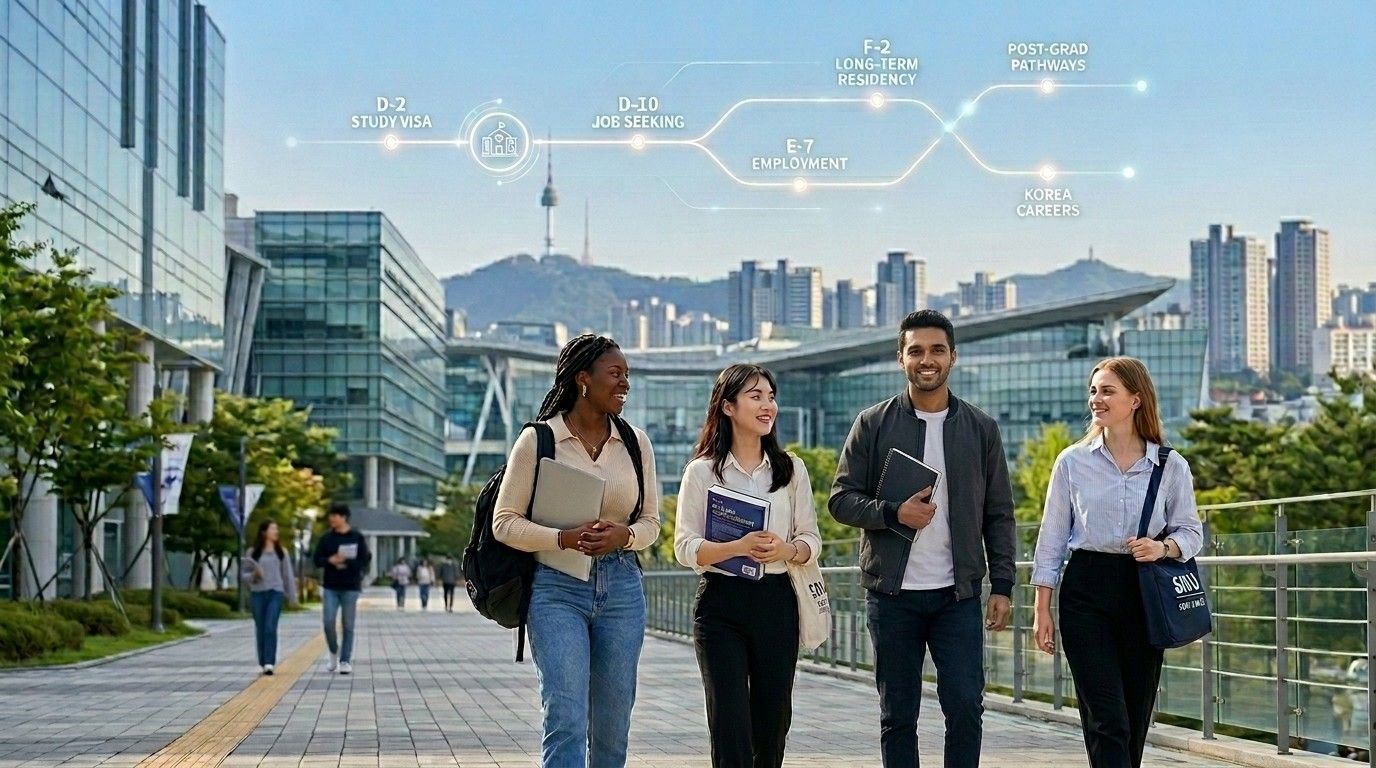
Look, I will be completely honest with you. A few years ago, coming to South Korea was mostly about K-Pop, K-Dramas, and short-term exchange programs. But in 2026, it has entirely changed. South Korea is actively looking for global talent. Through their “Study Korea 300K Project,” the government is trying to bring in 300,000 international students by 2027, and more importantly, they want you to stay & settle here.
If you are planning your future and wondering if a move to South Korea is worth it, you need to know the real facts. Let’s walk through exactly how you can manage part-time work in South Korea, transition into a career with PSW, and ultimately unlock life-changing PR opportunities.
Part-Time Work in South Korea
Surviving and thriving as a student in South Korea means you need an income. Fortunately, finding part-time work in South Korea on a D-2 student visa is highly accessible, provided you follow the rules.
Your working hours in South Korea are directly tied to your Korean language proficiency (TOPIK level). The government rewards students who learn the language. In 2026, undergraduate students can typically work between 20 and 25 hours per week during the semester. If you have a high TOPIK score (Level 3 or 4+, depending on your year), you unlock the maximum hours. Master’s students can work up to 30-35 hours.
During summer and winter vacations, you can work unlimited hours. With the minimum wage around 10,000 KRW or $6.50 USD per hour, working part-time is a fantastic way to cover your rent and living expenses. My advice would be, “Do not ignore learning Korean. Even if your degree is 100% in English, learning Korean is one of the best ways to land better-paying, comfortable part-time work in South Korea. You can work in university admin jobs, tutoring, or translating instead of washing dishes.”
PSW in South Korea (Post-Study Work)
Remember, graduation day is not the end of your visa; it is the beginning of your career in South Korea. The system for PSW in South Korea is highly structured and far more welcoming than it used to be. When you graduate, you don’t have to return to your home country. You can easily switch to the D-10 Job Seeker Visa and extend your stay.
How it works
The D-10 visa allows you to stay in the country for up to 6 months to look for a professional job. You can extend this visa up to 2 years (using a points-based system evaluating your degree, age, and TOPIK level). Once you find a company willing to hire you in a professional field related to your studies, you transition to the E-7 Skilled Worker Visa. This is your golden ticket.
The government has recently lowered income requirements and relaxed quotas for E-7 visas, especially for international graduates from Korean universities in tech, engineering, and global business sectors. Finding PSW in South Korea has genuinely never been easier if you have the right skills.
PR Opportunities in South Korea
Most international students come to South Korea to build a permanent life here. For this, you need to understand the PR opportunities in South Korea. Going straight from a student to a permanent resident (F-5 visa) takes time, but there is a brilliant starting point: the F-2-7 points-based resident visa.
Think of the F-2-7 as the “VIP Pass.” It gives you ultimate freedom to live, work, or start a business in Korea without being tied to a single employer. To get it, you need to score at least 80 out of 120 points based on your age, income, education, and Korean proficiency. Graduating from a Korean university gives you massive bonus points.
After holding an eligible visa (like the E-7 or F-2-7) for 3 to 5 years, passing the Korea Immigration & Integration Program (KIIP), and meeting the income threshold, you can apply for F-5 permanent residency. Getting a PR in South Korea is very realistic nowadays.
The government specifically fast-tracks STEM (Science, Technology, Engineering, Mathematics) graduates and those settling outside of the overcrowded Seoul metropolitan area. So keep this in mind while applying.
Your Visa Progression Roadmap
To make this super simple to screenshot and save, here is your typical progression timeline:
| Visa Type | Purpose | Duration/Validity | Key Requirement for Success |
| D-2 | Student Visa | Duration of Degree | Learn Korean (TOPIK) for better part-time jobs. |
| D-10 | Job Seeker (PSW) | 6 to 24 months | Active job hunting and networking. |
| E-7 | Skilled Worker | 1 to 3 years (Renewable) | A solid job contract related to your major. |
| F-2-7 | Long-term Resident | 1 to 5 years (Renewable) | Earning 80+ points (Age, Education, Income, TOPIK). |
| F-5 | Permanent Resident | Permanent | 5 years of residency, good income, passing KIIP. |
Now Is the Best Time to Start Your South Korean Journey!
South Korea is now facing an ultra-low fertility rate of 0.72 in 2025, with the population projected to halve by 2100. The government’s “New Immigration Strategy 2026-2030” targets 300,000-400,000 net foreign worker inflows annually by 2030, up from approximately 200,000 in 2025.
Korea needs international talent, and the immigration system is being redesigned to attract and retain it. The 2026 policy changes, including simplified D-10 access, K-STAR fast-track PR, and expanded work hours for TOPIK holders, aren’t random. They’re strategic and you should take advantage of them.
Students who begin their South Korean journey now are entering a system actively being made more accessible, more transparent, and more rewarding for international graduates.
So, are you interested in studying in South Korea? Navigating visas, university applications, and language requirements can sometimes feel confusing. But it is entirely possible when you have the right team with you. If you are ready to take advantage of opportunities in South Korea, we are here to guide you.
Aspire Global Pathways (AGP) is dedicated to helping ambitious students like you build global careers. From university selection to visa guidance, our experts make it simple. Contact us today for free expert guidance. Let’s secure your future in South Korea smoothly!
Frequently Asked Questions (FAQs)
- Is it easy to find part-time work in South Korea for international students?
Yes! Finding part-time work in South Korea is highly accessible for students on a D-2 visa. You can legally work up to 20-30 hours per week during the semester and unlimited hours during holidays. However, having a good TOPIK (Test of Proficiency in Korean) score drastically improves your chances of finding better-paying, more comfortable jobs.
- How does PSW in South Korea work for international graduates?
PSW in South Korea is managed primarily through the D-10 Job Seeker Visa. After graduating, you can stay in Korea for up to 2 years to find professional employment. Once hired, you can easily transition to an E-7 Skilled Worker Visa to begin your long-term career.
- What are the best PR opportunities in South Korea for students?
The best PR opportunities in South Korea start with the F-2-7 points-based visa. By earning points through your Korean university degree, age, and language skills, you gain residential freedom. After residing and working in Korea for 3 to 5 years, you can apply for the ultimate F-5 permanent residency visa.
- Can I get Permanent Residency (PR) in South Korea if I only speak English?
While you can study and find initial employment in English, securing long-term PR opportunities in South Korea requires Korean language proficiency. You will need to complete the KIIP (Korea Immigration and Integration Program) or achieve a high TOPIK level to qualify for the F-5 Permanent Resident visa.
- How much can a student earn doing part-time work in South Korea in 2026?
With the minimum wage around 10,000 KRW or $6.50 USD per hour, a student working the standard 20-30 hours a week can earn approximately $573 to $860 USD per month. This part-time work in South Korea is generally enough to cover standard living expenses, food, and transport outside of tuition fees.